Research Ideas
As artificial intelligence technology continues to develop in the field of mental health, I have gradually become interested in the relationship between artificial intelligence-assisted anxiety intervention and its implementation process. Given that artificial intelligence-based chatbots and digital intervention tools are being widely used to improve the accessibility and scalability of mental health services (Lattie et al., 2022; Vaidyam et al., 2019), how to understand the actual operation process of these interventions in real use scenarios has become an increasingly important research topic. Recent systematic reviews and meta-analyses have shown that AI conversational agents show certain potential in alleviating anxiety symptoms (Li et al., 2023; Li et al., 2025).
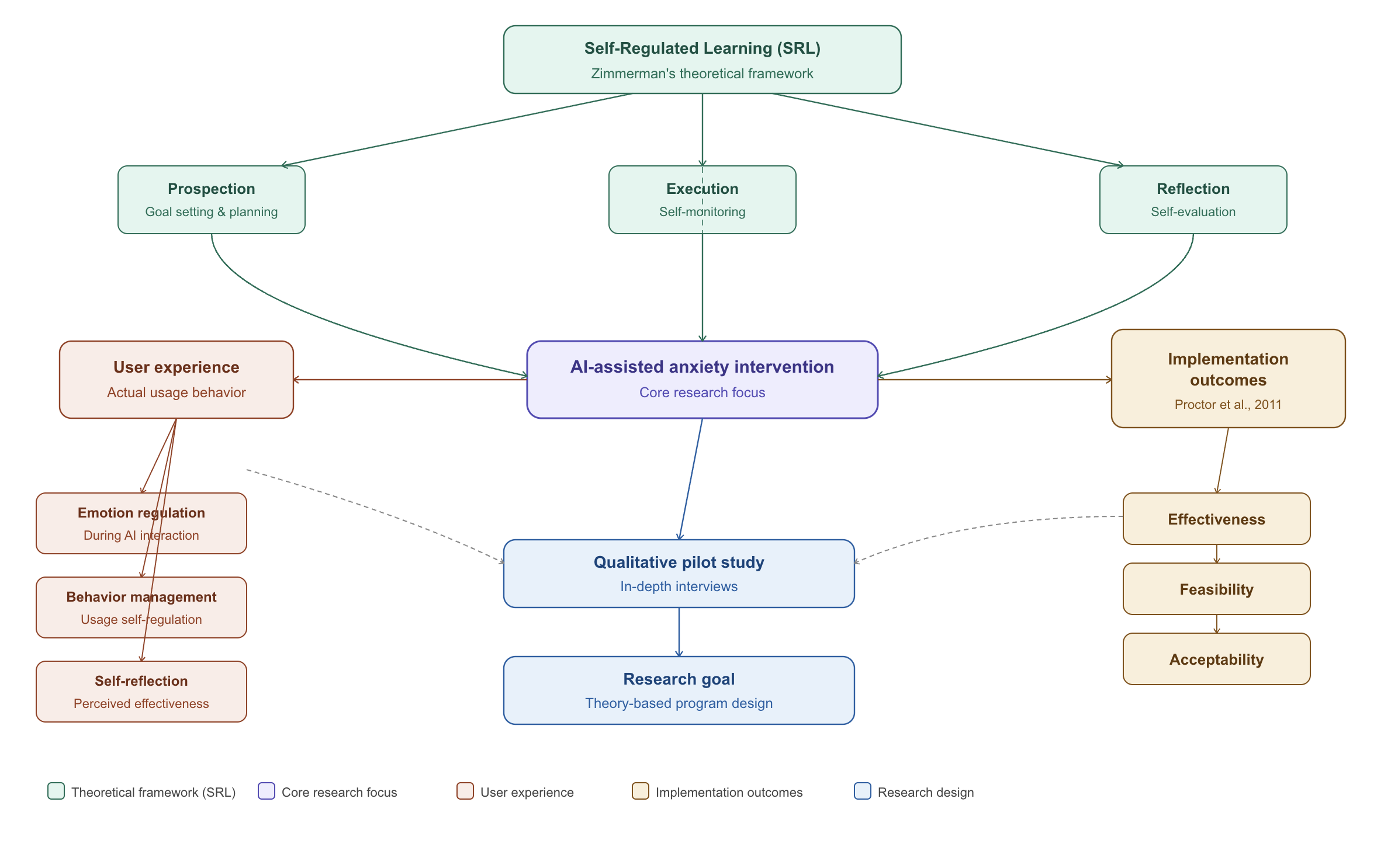
Specifically, existing research largely emphasizes symptom improvement effects versus technical performance. At the same time, in the field of implementation research, implementation outcomes such as effectiveness, feasibility and acceptability have also gradually received attention (Proctor et al., 2011). However, although there have been studies that have explored the effects of AI intervention in experimental or preliminary application situations, fewer studies have deeply analyzed the adjustment process experienced by users during actual use, and how these implementation results are gradually formed during the interaction process (Vaidyam et al., 2023).
Based on the research gaps identified in the systematic literature review, I hope to further explore individuals’ actual experiences using AI-assisted anxiety intervention tools. In particular, I focus on how users regulate their emotions during interactions with AI, how they manage their own usage behavior, and how they self-reflect on the effects of intervention. With the help of the Self-Regulated Learning (SRL) theory proposed by Zimmerman, I hope to understand the user’s self-regulatory activities during the use of intervention from the perspective of three stages: prospection, execution and reflection.
Considering that different individuals have different ways of managing emotions and coping with situations, I plan to conduct a pilot study of qualitative interviews to explore how users describe their interaction experiences with AI tools in their specific life situations, and how these self-regulation processes are related to their understanding of the effectiveness, feasibility, and acceptability of the intervention. Through this exploration, I hope to provide conceptual support for the subsequent construction of a more theoretically based and practice-oriented research program.
Concept Map
 Jingyi Dekyi Yang